
SHENZHEN, China — Cody Tseng is folded into the evening rush the way everyone else is in this city, absorbed by a current of twenty million people, one more developer heading home through streets that never fully dim. The metropolis, often styled as China’s Silicon Valley, rose from rice paddies in a single lifetime, and the pace shows: most of its residents work for somebody else's company.
So does Cody. He writes backend code at a small firm. Nothing too special, he says. Just a pretty ordinary path.
Then he goes home, rests for a while, and connects his laptop to an external monitor. On that screen, his project has been branching without a master plan, crossing into countries he has never visited, picked up by strangers who forked his code and built their own versions. He browses those versions himself, mining them for ideas he hadn't thought of.
"I'm a person with no much planning and often change my mind randomly," he says. The only fixed point is a line in his GitHub profile: four characters in Chinese, 随心而动. Follow your heart.
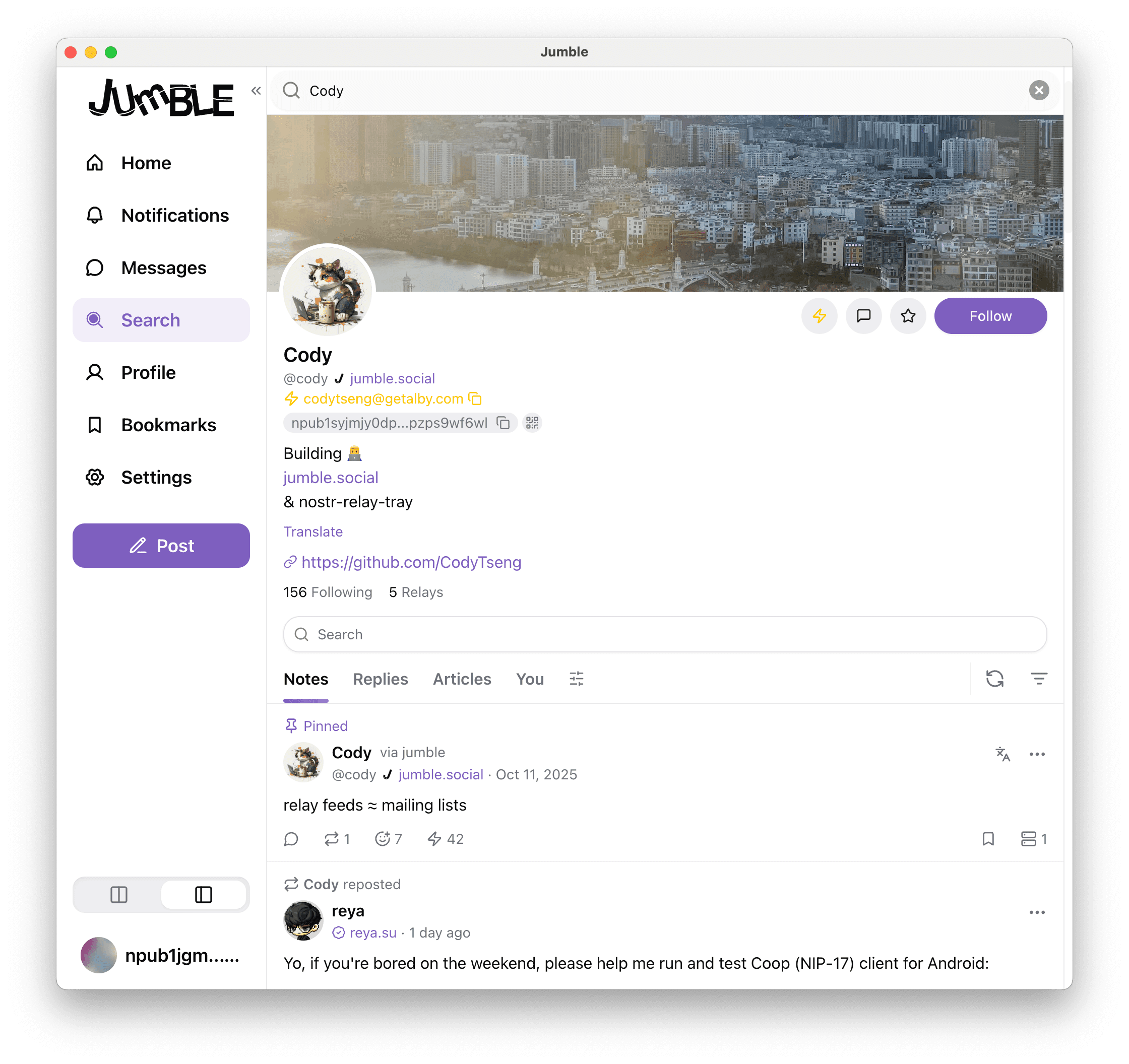
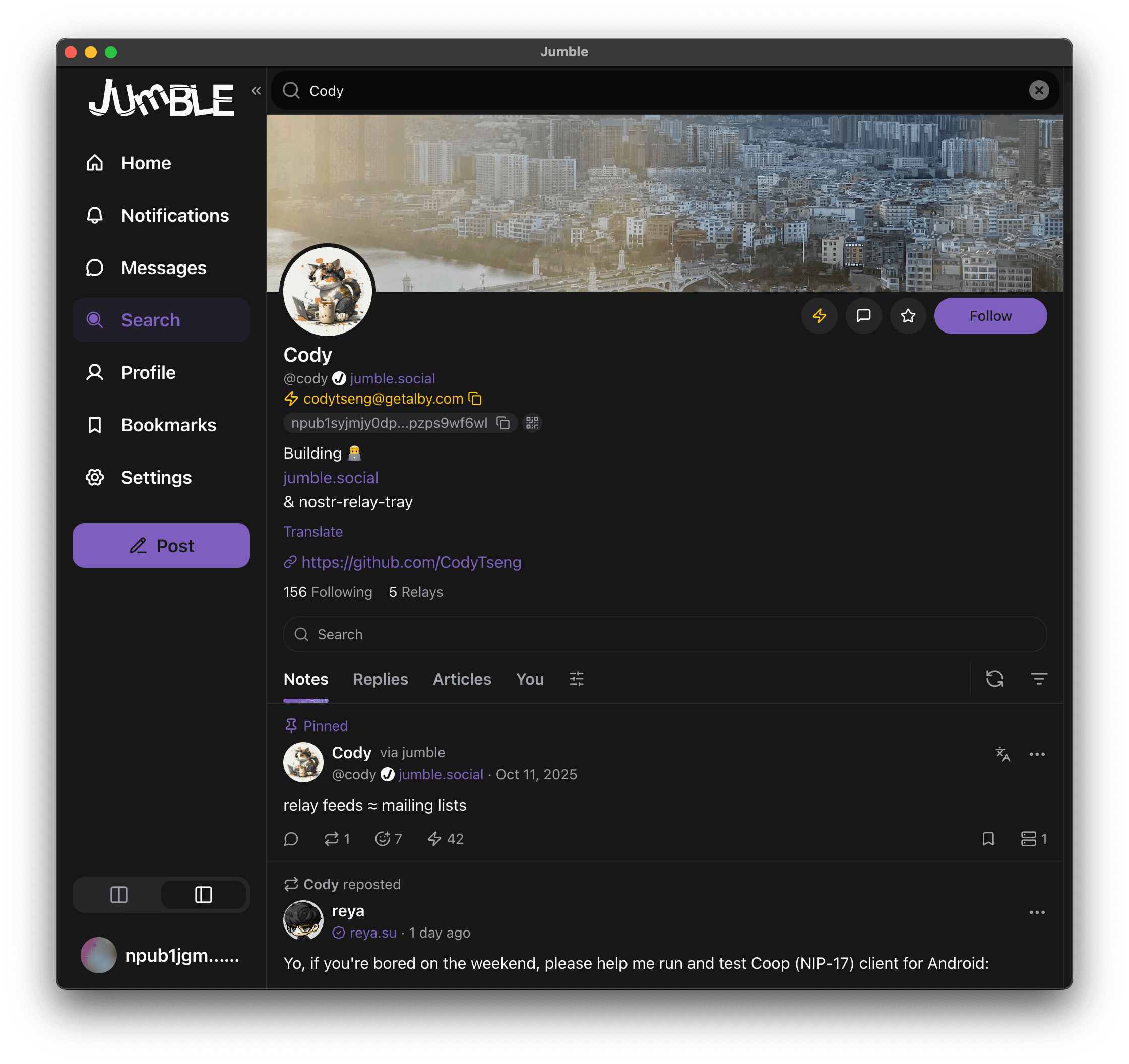
The project is called Jumble. Open it in a browser and you see what you might see anywhere: posts, photos, and strangers saying GM — good morning — to the internet, and other mumble jumble. What makes it different is that nothing has been curated before you arrive, and posts sit without scores beneath them. Jumble refuses the usual sugar rush of the social web. It asks a question most apps have long since answered for you: what do you want to read?
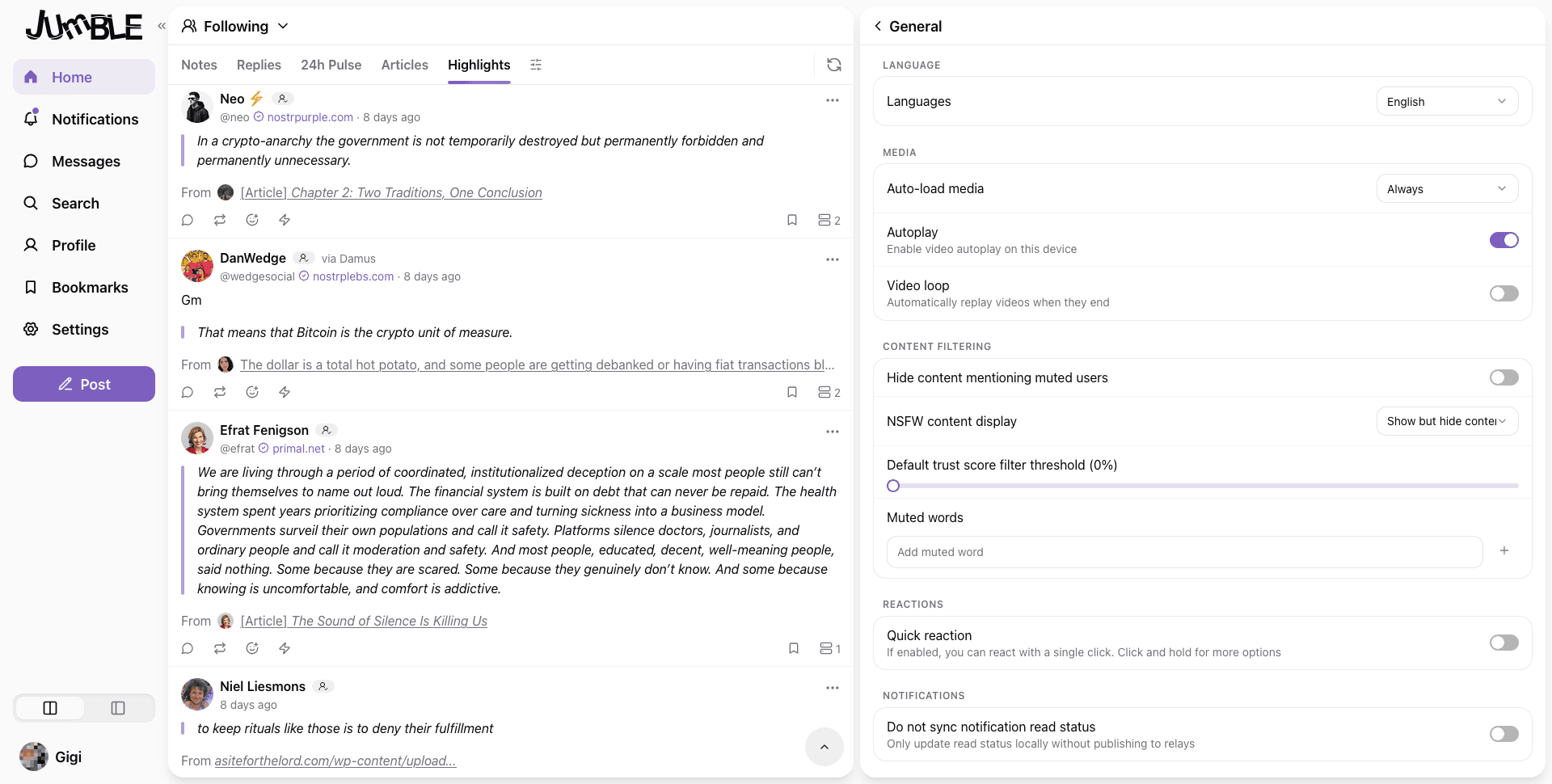
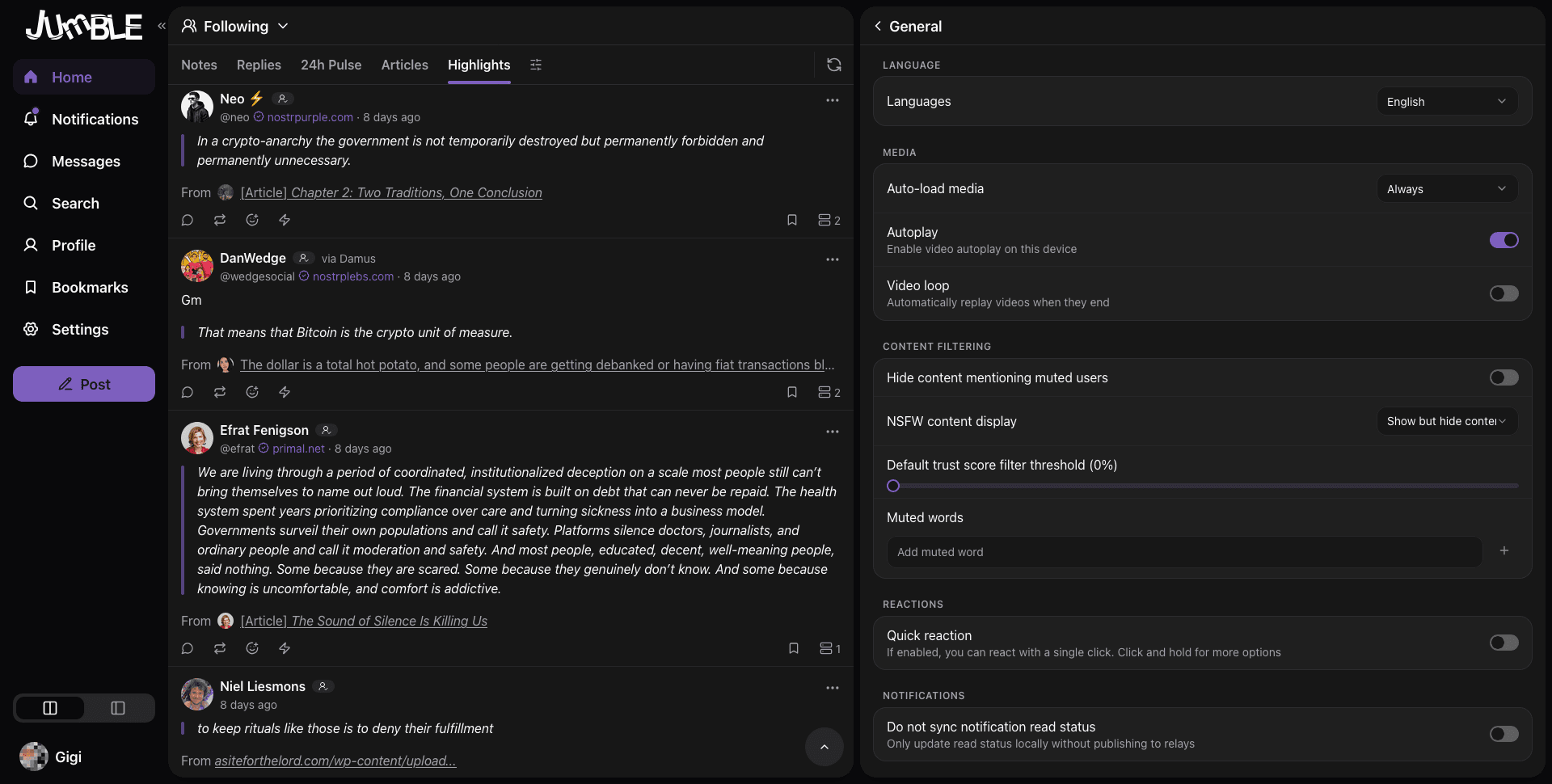
Most social media is a building someone else owns. They built the walls, set the rules, and kept the keys. Your account, posts, and followers all live inside it. Every profile looks the same, arranged identically, offering the same options. Boring, suburban gated communities, the whole lot of them. If they change the terms, it's their way or the highway.
Jumble is built on Nostr, where your identity is tied to a private digital key that only you hold. Small servers called relays, run by people around the world, pass messages along without owning the account behind them. No company can silence your account because no company owns it, or Nostr itself.
Other contenders include Amethyst, Coracle, and Damus. But where many of them try to make Nostr feel familiar, Jumble lingers on the part most apps hide. What distinguishes Jumble is that it makes the hidden geography of Nostr visible.
Even fiatjaf, the pseudonymous developer who invented Nostr, advocated Jumble a year ago: “Jumble is looking like it could become the best web client in existence.” Cody counts it as his proudest moment. "I'm not very good at promotion, and I don't really have strong influence in that area," he says. Being found by the person who built the world he works inside means more than anything.
That instinct goes back further than Nostr. Cody was a kid who wanted to make video games. Trying to make games pulled him first into drawing, then 3D modelling, then code, each step following naturally from the last, pulled forward by the pleasure of building something that worked. When he eventually began fixing open-source software, finding the broken line and sending the repair back to the people who maintained it, the satisfaction landed right away: his code, running inside a project used by strangers. That feeling is, he says, what has driven him ever since.
Like most children in China, his life was structured around a single variable: examinations. School, exams, more school, more exams, all the way to university, and none of it suited him. "I was never the kind of student who followed rules very well," he says. "I disliked exams and memorizing things that felt meaningless to me." The consequence was a university he hadn't aimed for and a major that wasn't computer science. Rules that felt arbitrary always chafed him. So he follows his own code.
Outside of those structures, he moves at a different pace. On weekends he walks with his girlfriend, to the sea, through parks, into bookstores, to restaurants they haven't tried before. He doesn't plan far ahead. The four characters on his GitHub profile are, he says, a reminder not to overthink, to act on what feels right inside.
He doesn't remember exactly when he first encountered Bitcoin, only what made him stay.
Like many people, I dislike being controlled and want to truly own certain things. I think many Nostr users feel similarly. They want to truly own their data instead of having it locked inside the databases of large companies.
Bitcoin has a four-word phrase for this conviction: your keys, your coins. An entire financial life could be compressed into twelve memorised words, crossing any border without being declared.
When asked how he came across Nostr, he said the idea had been waiting in him. More than fifteen years ago, before he had the skills to build it, he had already imagined something very like what Nostr would become — a social network nobody owned, where your posts stayed yours. When Bitcoin led him to Nostr, he recognised its shape immediately. He was struck by its elegance, as if it solved a problem he had been carrying for years.
The design of Nostr is extremely simple. You can describe its core principles in just a few sentences, but at the same time it is incredibly powerful, enough to build full social applications on top of it.
Cody built nostr-relay-tray, a small desktop application for running your own personal relay. His shrewd idea was to give local bookstores and corner cafés a way to run a relay accessible only to local Wi-Fi customers. Customers who connected could browse it, leave messages, and find traces left by whoever had sat in the same spot the week before.
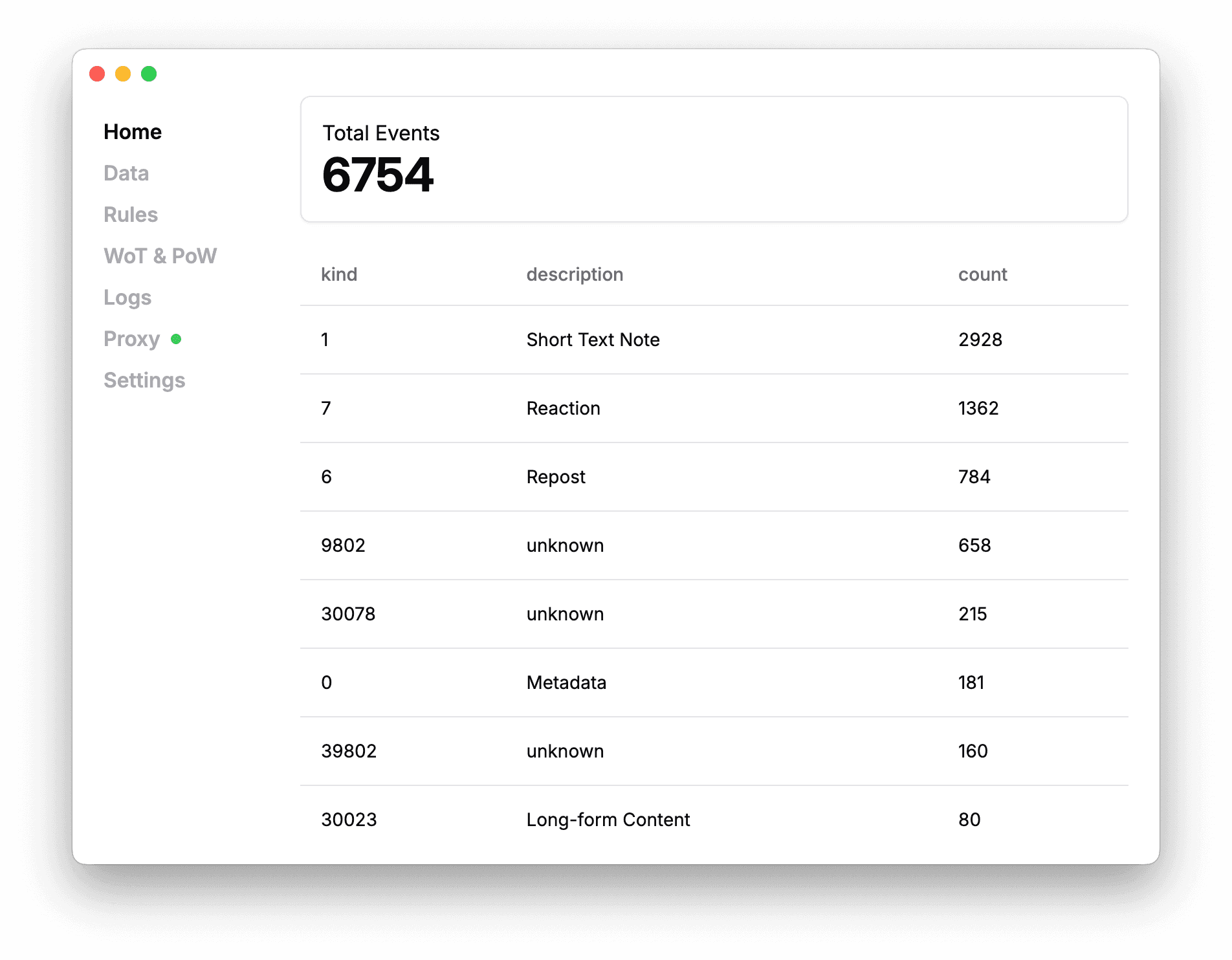
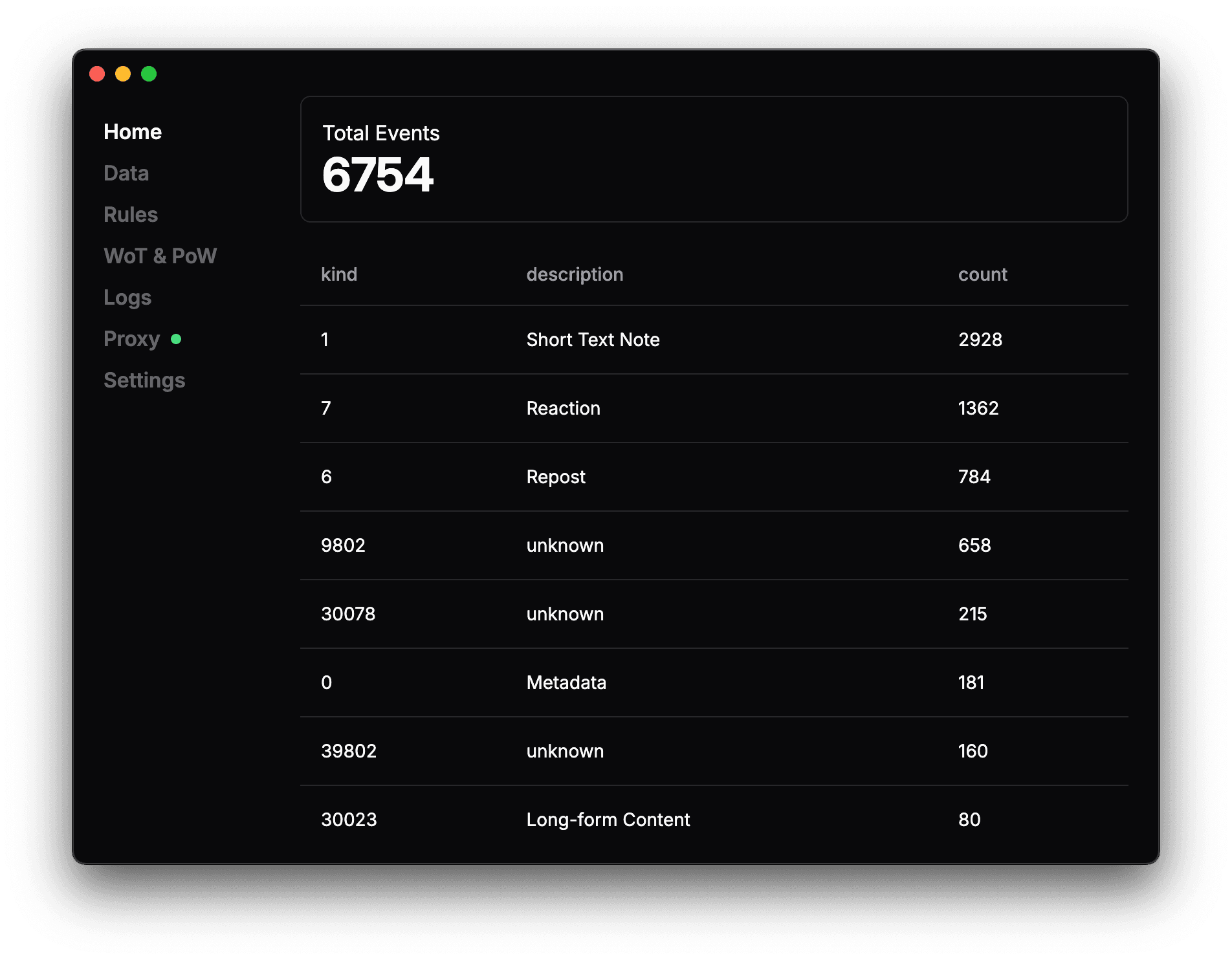
He added a way to browse the messages flowing through his own relay almost as an afterthought. Three months later, it had devoured the original project. "I think it would be pretty interesting," he said, "if in the future every physical place had its own small relay preserving traces left behind by the people who had been there."
While no single company can remove or block a post from the whole network, that does not mean users are left alone in an unmoderated wilderness. The social order on Nostr is assembled in layers.
A relay can refuse to store content that violates its own rules, like a host deciding what kind of behavior is welcome in their house. An app can choose what it shows, filtering at the level of the interface rather than the server. Individual users can mute and block trolls as always. And relay communities, whether built around a shared language, a city, or a common obsession, can develop their own standards over time, with moderators who emerge from within rather than from a corporate payroll
But the same architecture that removes central control also removes the conveniences that came with it. A follower count is no longer a single number pulled from a database; it depends on which parts of the network an app has looked at, which is practically never all of it. The same uncertainty touches search, deletion and spam. What looks like one button on a company-owned platform becomes a set of choices spread across apps, relays and users.
“Many clients try to fully recreate the experience of traditional centralized social apps on top of Nostr, but I don't think that is realistic,” he says. The point, for him, is not to rebuild Twitter with different plumbing. It is to accept a different bargain: less control by any single company, and more responsibility placed on users, communities, apps and relays to decide what they are willing to see, where they want to gather and whom they choose to trust.
That said, the “Great” Firewall complicates things in ways that outsiders rarely map precisely.
Cody is careful not to overdramatise the Chinese internet. "The Chinese internet itself is actually very diverse," he says. "People share daily life, jokes, technology, art, and many other kinds of content. Chinese internet users are also generally very friendly."
The system that sits behind the Chinese internet runs on different rules. Posts can be deleted on a whim, keywords are routinely filtered, and the companies hosting your words also keeps meticulous watch over everyone. Orwell would recognise the architecture. Nostr is harder to pin down, but not beyond reach. Cody says flatly that “using a VPN is basically required for development work”, and “without a VPN, using Nostr is more limited.”
The Firewall does not block every unknown relay by default. It blocks the ones that have been noticed, which means that, for now, obscurity is its own form of protection. "Once you are using a VPN," he says, "where you are physically located starts to matter a lot less." He laughs, as if the obstacle is real but not where the real difficulty lies.
Personally, I think improving the Nostr ecosystem itself is ultimately more important. Network access problems can usually be worked around one way or another, but whether the ecosystem is actually useful and interesting matters more.
Cody admits that if he wasn’t developing Jumble, he’d probably not even use Nostr that much. The content on X, Reddit, RedNote, and elsewhere is simply better. But that leaves Nostr with a chicken-and-egg problem: people need a reason to come before there is much to read, and there will not be much to read until more people come. To grow beyond builders and believers, it must offer reasons to stay that have little to do with private keys or digital ownership. People go where other people already are.
My vision is that in the future, when people talk about Nostr social applications, they will naturally think of Jumble.
But.
Maybe Nostr will never be accepted by the majority of people. Even when centralised platforms make mistakes and upset users, people usually still do not leave easily, and large companies will always try to recover those users somehow.
What Nostr needs most, in his view, is a greater diversity of places. Most relays today function like public squares: open, neutral and accessible. Cody hosts such a community for people all around the world who speak any of the Chinese dialects, representing a miniature experiment he advocates for.
The experiment shows how a relay is defined by its community interest, in this case language, rather than by its generality. Cody wants to see more relays forming around communities where like-minded people share a common obsession, be it food, music, books, and whatnot. These communities would also, he notes, help Nostr shed its reputation as a network primarily for Bitcoin advocates.
But he draws a careful line. “I am not saying we should become Mastodon.” In Mastodon, a server functions like a home; if it closes, your posts go with it. In Nostr, a relay does not own you. It is a place you pass through, gather around, or choose to publish to. A community relay is a place to gather, not a home that owns you. And the public squares, the open relays anyone can access, must remain. They are what keep Nostr genuinely open, rather than turning it into a collection of walled gardens with weaker walls.
How to attract the people who would build and tend these communities is a question nobody has answered yet. It is not obvious who should do the heavy lifting, or why. His intuition is that the answer involves learning from the platforms Nostr exists as an alternative to, studying how the big platforms keep groups alive, and borrowing what actually works.
I think the meaning of Nostr is that it provides another option. It shows people that another kind of network is possible.
If Nostr's promise is control over one's digital life, the test is whether ordinary users can feel that control without first learning how the machine works. Cody cannot resolve the larger question of whether Nostr will reach beyond those who already know why it matters. But what he is building, steadily and in the open, may help the answer emerge in its own time.
He doesn't talk like a rebel, but his work tells a different story. After all, Jumble follows an older cypherpunk tradition: don't ask permission, write code. He chafed exams he found meaningless, imagined a social network nobody owned before he could build one, and added a feature to a project almost as an afterthought, and watched it become the thing itself. Each time, he follows his heart, not knowing where it will lead.
随心而动.
Cody is a recipient of an OpenSats grant, awarded in November 2025, supporting one year of Jumble's development. “OpenSats support allows me to temporarily stop worrying so much about income or about boring career things like promotions at work,” he says. “It allows me to spend more time and energy on personal projects.”
If you want to support Cody, recommend Jumble to your friends and join the new social web. Our support for Cody’s work was made possible thanks to your generous donations to the General Fund. For comments, corrections, or suggestions about our Spotlight series, please reach out to spotlight@opensats.org.